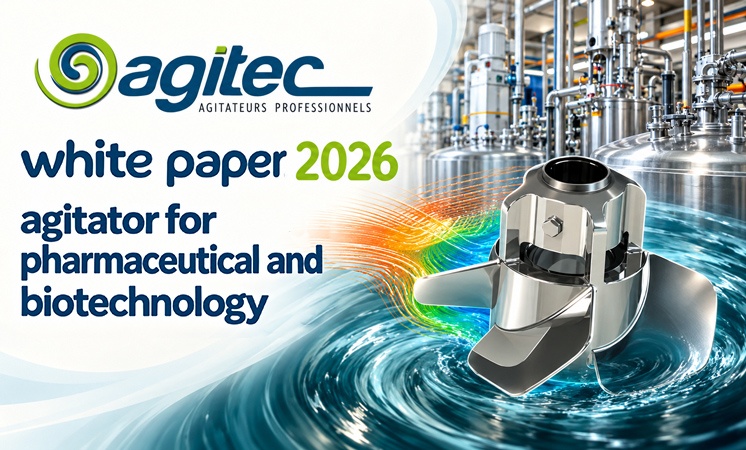


How to choose the right agitator for the pharmaceutical industry
A satisfactory result in the laboratory does not guarantee either the same consistency in production or the compliance of the equipment. So, how can one define the desired effect, validate the design specifications and integrate pharmaceutical requirements at the various stages of process maturity?
To answer these questions by underpinning each decision with concrete data, Agitec offers a new 36-page white paper: « Key criteria for choosing the right agitation system in the pharmaceutical industry».
DISCOVER A comprehensive guide, enriched with industry feedback
Spanning 36 pages, this white paper brings together the key insights needed to:
- link each blending objective to the main categories of active ingredients;
- prioritise the key physico-chemical properties;
- understand the parameters for sizing and scale-up;
- incorporate hygiene and regulatory constraints;
- balance performance, consumption, maintenance and overall cost;
- avoid several recurring errors observed in the field.
Finally, industrial case studies demonstrate how these choices come into play during a capacity increase, a re-industrialisation project or the optimisation of an existing plant.
From an expert perspective, a wide range of topics will be covered, such as:
Risk management tailored to the product to be blended
This white paper will help you refine your knowledge so that you can precisely definethe objective of the blending processbefore comparing technical solutions. Our guide sets out the questions to ask at an early stage to characterise the environment and steer the choice towards the most relevant families of mixing elements, without reducing the decision to a single rule.This is because we sometimes find that the selection process is approached the wrong way round: a family of actuators is shortlisted, and then attempts are made to verify whether it is suitable. However, the starting point should always êbe the desired effect.
How to transform process data into a coherent sizing approach?
The white paper breaks down the parameters to be considered during sizing and shows how testing, feedback from experience and CFD studies can help to visualise flow patterns, identify dead zones and compare different configurations prior to manufacture.Indeed, the product’s properties directly influence the agitator’s response, but no single parameter can be interpreted in isolation. It is the interaction between the medium, the vessel and the scale that determines the actual behaviour of the mixture.
Our guide helps you identify the relevant data, understand its impact on your choice and avoid oversimplifying the sizing process. In particular, it explains why higher power output does not automatically mean better performance.
Why incorporate pharmaceutical requirements right from the design stage?
In the pharmaceutical industry, hydraulic performance is only part of the answer. The chosen system must also be capable of being cleaned, qualified and operated in a reproducible manner.The white paper shows how to incorporate these requirements early enough for them to genuinely guide the design. It also places the purchase price within a broader context: a suitable solution must remain effective throughout its operational life, without generating excessive energy consumption or avoidable downtime.
A word about the author
This white paper was written by Grégory Badey (in french), Chairman of Agitec. Having been with the company since its early years and at its helm since 2014, he ensures that the choice of mobile units, the principles of agitation and the constraints of the facilities are all aligned. Here, he shares his experience in the form of a decision-making method that can be applied right from the project planning stage.Furthermore, the company Agitec has been designing and manufacturing standard or bespoke agitation solutions for over 30 years. The company is involved right from the stage of defining requirements and can verify the behaviour of the mixture through testing or CFD prior to manufacture. This comprehensive understanding of the entire project underpins the approach taken in the white paper: viewing the agitator as a whole, as a component that evolves alongside the maturity of the process, rather than as a part selected in isolation at a given point in time.
Are you planning a new installation, a scale-up or the overhaul of an existing process?
Download the white paper to gain a structured approach, identify the data you need to collect and approach your choice of agitator with the right questions.