

Meeting the challenges of extrapolating agitation systems to industrial scale
Extrapolating laboratory agitation systems to industrial scale is a major challenge for process industries. The aim is to reproduce the performance obtained in pilot tests on a large scale in order to guarantee the same mixing quality, the same material or heat transfer and, ultimately, the same reaction efficiency. However, moving from a reactor of a few litres to a tank of several cubic metres requires careful study: many parameters come into play and the phenomena do not translate linearly.
This multidimensional challenge, at the crossroads of hydrodynamics, heat transfer, mechanics and economics, requires a methodical approach and a solid theoretical basis. Let us examine these issues and challenges of large-scale extrapolation point by point.
Theoretical foundations and issues of extrapolation
Scale transposition in agitation is based on the principles of similarity: geometric similarity (constant dimension ratios), dynamic similarity (proportional inertial, gravitational and viscous forces), kinematic similarity (same reduced velocities), etc. In theory, maintaining certain dimensionless numbers (Reynolds, Froude, etc.) between the pilot and industrial scales should make it possible to reproduce the same mixing effects. However, in practice, it is impossible to keep all criteria constant simultaneously: a choice must be made.
The major theoretical challenge is therefore to identify the predominant phenomena in the process (dispersion, homogenisation, reaction, etc.) and to determine which similarity criteria to prioritise during extrapolation.
For example, deciding to keep the mixing intensity (power per volume) or the mixing time constant will have very different consequences on other variables (velocity gradients, flow regime, etc.). Taking these theoretical bases into account is essential in order to anticipate the differences due to the change of scale and lay the foundations for a successful scale-up.
Choosing the right extrapolation criteria >
Challenges related to hydrodynamic scale effects
As the scale changes, the hydrodynamic conditions in the tank evolve in a non-linear manner, posing significant challenges. One of the typical problems is the drastic increase in the energy required to achieve the same level of mixing as in the laboratory. For example, to maintain the same mixing time in a much larger vessel, the agitation power required must increase exponentially – often faster than the equipment allows. Compromises must therefore be made: reducing the rotation speed to limit the power required, at the cost of a longer mixing time.
In addition, the nature of the flow can change: a fully turbulent regime on a small scale can become partially laminar locally if the speed is not increased proportionally, and dead or poorly mixed areas can appear in the corners of a large tank. The Froude number, linked to the effects of gravity (surface vortices), also illustrates these challenges: keeping it constant often requires a high rotation speed on a large scale, otherwise the surface dynamics (air entrainment, vortex formation) will behave differently. All these hydrodynamic scale effects require engineers to be extra vigilant during scale-up: controlling changes in mixing times, shear rates and turbulence according to the size of the tank is essential to avoid unpleasant surprises.
MEETING THE CHALLENGES OF HYDRODYNAMIC SCALE CHANGES >
Practical difficulties of extrapolation in an industrial environment
Beyond theoretical principles, extrapolation to an industrial scale faces many practical constraints. Firstly, the geometry of the equipment itself may differ: it is not always possible to maintain exactly the same d/D ratio (mobile diameter to tank diameter) or the same number of counter-blades as in the pilot plant, due to equipment availability or civil engineering requirements. It is sometimes necessary to resort to non-geometrically similar adaptations, for example: opting for a propeller with a larger relative diameter in order to better cover the volume, or installing several stages of moving parts on the same axis in a very tall vessel. These adjustments compensate for certain scale effects (e.g. reducing the maximum velocity gradient by choosing a larger impeller rotating more slowly), but they complicate the direct transposition of laboratory results.
Furthermore, certain sensitive processes impose limitations: a medium containing microorganisms or fragile particles will not tolerate excessive shear, which may prevent simply increasing the speed on a large scale. It will then be necessary to devise alternative solutions (different agitator, injection closer to the agitated area, etc.).
Added to this are the uncertainties of the real industrial environment: the presence of exchangers (coils) or sensors in the tank can disrupt the flow compared to a bare laboratory tank, as can variations in the properties of the fluid (viscosity may change with temperature, etc.).
In addition, the profiles of the mobiles must be taken into account. Some profiles are suitable in the laboratory to achieve a mixing effect where they are inappropriate on an industrial scale. For example, a Rushton turbine (with its high energy consumption) is suitable in the laboratory phase, because it is small-scale, for homogenising a mixture and heat exchange, but is inappropriate in the industrial phase (too much power required) . Similarly, a laboratory magnetic bar for mixing has a profile that cannot be extrapolated to an industrial scale.
All these practical difficulties make scale-up tricky: it is not enough to apply a formula, it is also important to take into account the realities of the field, technological limitations (maximum motor power, agitator shaft dimensions) and sometimes accept operational compromises.
Adapting extrapolation in practice in an industrial environment > (Coming soon)
Large-scale heat and mass transfer
When scaling up, heat transfer and mass transfer often become limiting factors that need to be anticipated. This is because a large tank has a lower surface area/volume ratio: removing the kilojoules from an exothermic reaction or heating a large volume evenly is much more difficult than in a laboratory. The risk of temperature gradients arises if the agitation and heat exchange systems (calender, coil, double jacket) are not correctly sized and operated.
To maintain good thermal homogeneity, it is essential that the mixer ensures effective sweeping of the walls and exchangers: this often calls for agitators with a high pumping rate (high axial flow) in order to constantly renew the fluid in contact with the exchange surfaces.
For example, a large-diameter turbine rotating at moderate speed will create a volumetric movement that improves heat transfer, whereas a small, fast propeller would risk generating more heat than it dissipates.
Similarly, material transfer (dissolution, gas absorption, etc.) is greatly affected by changes in scale. The amount of oxygen dissolved in an industrial fermenter or the rate of gas absorption in a 50 m³ reactor can drop if the pilot conditions are simply maintained without adjustment. For example, introducing a gas at a flow rate proportional to the volume can, on a large scale, lead to bubbles that are too large and poor dispersion of the gas in the liquid: the gas passes through the tank without dissolving properly. The solution is then to increase the agitation power and moderate the gas flow to restore effective absorption.
In general, ensuring good mass transfer on a large scale often involves injecting more energy per volume (or using special devices, such as dispersing turbines or optimised spargers) to compensate for the lower specific surface area of bubbles or droplets in large volumes.
In short, heat and mass transfer phenomena impose their own constraints during scale-up, and special attention must be paid to them to avoid behavioural deviations.
Effectively managing heat and mass transfer during extrapolation > (Coming soon)
Mechanical constraints and safety in industrial agitation
Scaling up to industrial level means handling large equipment with considerable mechanical constraints. An agitation device several metres in diameter driven by a motor of tens (or even hundreds) of kilowatts induces enormous stresses on the shaft, the gear motor and the tank structure. The mechanical strength and reliability of agitators are therefore major concerns: materials and components must be chosen that can continuously withstand vibrations, high torques and wear.
The dimensioning of the drive system (motor, gears, bearings) must take into account not only the power required for mixing, but also peak torques at start-up, fluctuations due to variations in the medium (e.g. presence of solids, wave effect or increase in viscosity during the process) and safety margins to prevent breakage. Sometimes, the power required for mixing, calculated theoretically, exceeds what a standard agitator shaft can withstand without buckling or breaking: in this case, the strategy should be modified (for example, using several agitators on the same shaft to distribute the load, or reducing the target rotation speed).
Operational safety is also at stake. A large mixer that is poorly designed or poorly controlled can cause accidents: catastrophic mechanical failure, uncontrolled heating due to lack of dissipation, or even explosion if an unstirred area accumulates reagents and causes a localised reaction. This is why, on an industrial scale, monitoring devices such as vibration or torque sensors, thermal safety probes, etc., are often integrated.
In addition, high safety factors are observed in the design. Furthermore, regulatory aspects (e.g., mixing flammable solvents in explosive atmospheres, sealing of shaft seals for pressure vessels) add further requirements. Ultimately, successful extrapolation depends not only on maintaining process performance, but also on ensuring that the agitation equipment will operate safely and reliably on a large scale.
Managing the mechanical design of industrial agitators > (Coming soon)
Instrumentation and control of large-scale processes
At the laboratory scale, an operator can often directly observe the mixture (uniform colour, absence of deposits, etc.) and manually adjust the agitation. In an industrial unit, it is impossible to see inside an opaque vessel several metres in size, and the slightest adjustment has a significant impact. Hence the importance of instrumentation and automated control to supervise large-scale mixing.
In practical terms, stirred tanks are generally equipped with multiple sensors: temperature probes distributed at various points to detect possible thermal gradients, pH or conductivity sensors to monitor the homogenisation of a solution, and even dissolved oxygen probes in fermenters to ensure that aeration/mixing is sufficient.
The torque or power absorbed by the agitator can be measured continuously via the variable speed drive, providing a real-time indication of the mixing load (a sudden variation may indicate foaming, obstruction or, conversely, complete dissolution). All this information feeds into a control system (PLC or DCS) that adjusts the process parameters: for example, automatically increasing the stirring speed if the temperature is not uniform, or modulating the reagent feed rate to allow time for mixing.
The challenge is to define robust control strategies inspired by the pilot scale and to ensure that the sensors provide reliable data despite difficult conditions (high pressures, corrosive products or sensor fouling). Good instrumentation not only ensures continuous mixing quality, but also enables safe operation: detecting deviations before they become critical (e.g. a thermal hot spot) and initiating corrective actions. Thus, large-scale extrapolation is always accompanied by increased process supervision, so that industrial agitation remains under control in all circumstances.
Applying instrumentation and control techniques to large tanks > (Coming soon)
Experimental and numerical approaches to improve the reliability of extrapolation
Faced with the complexity of scale-up, process engineers are increasingly relying on complementary experimental and numerical approaches to improve the reliability of extrapolation. The experimental approach involves conducting tests on pilot units or small-scale models: these test campaigns make it possible to verify similarity assumptions, measure key parameters (mixing time, transfer coefficients, etc.) under conditions close to industrial conditions, and identify any problems before building the production unit. It is often wise, for example, to test several types of agitators or configurations on a tank of a few cubic metres to see which one works best in terms of efficiency and mechanical constraints. In addition, the sophisticated instrumentation of these pilot plants (using imaging and multiple probes) provides a detailed understanding of the flows, which is difficult to obtain on a large scale. At the same time, numerical approaches have made great strides forward with computational fluid dynamics (CFD).
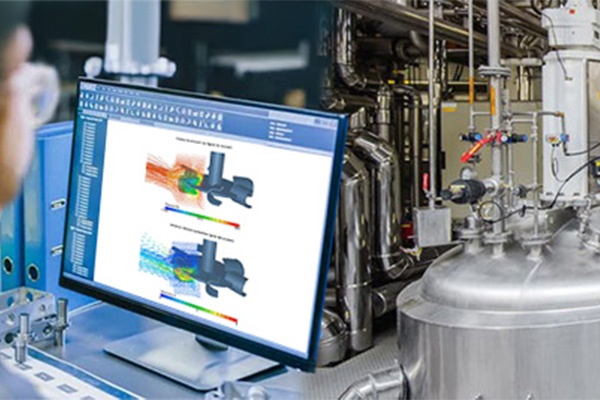
Numerical modelling makes it possible to simulate the behaviour of an industrial tank on a computer: velocity fields and less well-mixed areas can be visualised, and variables such as mixing time and kLa (gas-liquid transfer coefficient) can be estimated without having to immediately carry out costly tests.
Of course, these models must be validated by experimentation – hence the synergy between pilot testing and simulation. Once validated, they become powerful tools for optimisation: the addition of a counter-paddle, a change in speed, or the effect of higher viscosity can be tested virtually, thus guiding the design before full-scale implementation. Ultimately, combining experimentation (pilots, models) and digital technology (CFD, digital twins) greatly increases the reliability of extrapolation by reducing uncertainty. Engineers no longer rely solely on general correlations; they base their extrapolation on concrete data and detailed predictions, which limits the technical and economic risks involved in scaling up.
Successful scale-up with cutting-edge methods > (Coming soon)
Economic implications of extrapolation
Successful or unsuccessful extrapolation of an agitation system can have major economic consequences. On the positive side, well-conducted extrapolation optimises the process on a large scale: a suitable mixer will reduce processing times (for example, if homogenisation is possible in 30 minutes instead of an hour, this translates into increased productivity), potentially improve product yield or quality (fewer non-compliant batches due to heterogeneous mixing), and minimise energy consumption for a given performance. Optimising agitation therefore means reducing unit production costs – significant gains on a production scale of tonnes.
On the other hand, if the scale-up is poorly anticipated, the financial impact can be significant: imagine a reactor costing several million pounds whose inefficient agitation leads to failed batches or doubled cycle times, resulting in considerable lost revenue and additional operating costs. In the worst case, large-scale agitation problems can force emergency equipment modifications (changing agitators, adding counterblades, etc.): these retrofits during operation are always very costly and generate unplanned production stoppages. Integrating extrapolation constraints into the project at a very early stage, on the other hand, allows you to size the equipment exactly as needed – neither oversized (excessive investment for unnecessary performance) nor undersized (technical risk). A balance must therefore be found to ensure profitability.
Finally, the energy aspect should not be overlooked: a large-scale, energy-intensive mixer can increase utility bills day after day. Every kilowatt saved through a more efficient design (e.g. by choosing a more hydrodynamically efficient impeller) translates into financial savings over the unit's lifetime. In short, the economic implications of extrapolation go beyond the purchase cost of the agitator alone: they encompass the overall profitability of the industrial process, its reliability (avoiding losses due to mixing problems) and its energy performance.
Learn more about costs, potential gains and economic analyses > (Coming soon)
Ultimately
Ultimately, extrapolating an agitation system to an industrial scale is a balancing act, combining science and pragmatism. It is not enough to blindly apply a scaling law: it is necessary to understand the phenomena in depth, identify the critical points of the process and adapt the design accordingly. Theoretical foundations provide guidance – for example, knowing which similarity criteria to sacrifice or retain – but industrial reality often requires intelligent compromises. The hydrodynamic, transfer and mechanical challenges we have discussed clearly show that each aspect of the problem is linked to the others.
The key to successful scale-up therefore lies in a comprehensive, interdisciplinary approach, where processes and mechanical engineering go hand in hand, supported by pilot testing and simulation. Ultimately, the goal is to achieve the targeted performance on a large scale, safely and at a controlled cost. It is only through this rigour that a laboratory innovation can be transformed into a reliable and efficient industrial process.